

-
Katharine Graham
Former chairperson and publisher of the Washington Post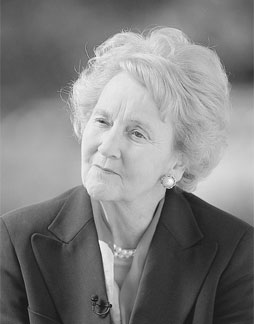 Katharine Graham
Former chairperson and publisher of the Washington Post"The Giant I Met in a Small Country in the East"
Ho-Am was a charismatic business leader, as well as a very charming person. Above all, I remember him as an extremely warm-hearted man. He was very kind even to those who were not familiar with managing a business or had little experience, like myself. When I later heard that many Koreans found Ho-Am intimidating, I was very much puzzled. While he may outwardly seem a bit reserved and stern, he was actually a person with a heart of gold. I hope he would be recognized not only as an excellent businessman, but also as someone who holds deeply human qualities.
Most people think business management is all about earning money. But in my opinion, Ho-Am was an exceptional business leader who was beyond having any desire for material comforts in life.
What impressed me the most when meeting Ho-Am was his extraordinary affection for his country and people. While Korea's unique historical circumstances may have shaped him into a patriot, there was clearly something special about his management philosophy. Most people think business management is all about earning money, and I know that Ho-Am had an extraordinary gift in that regard as well. But in my opinion, Ho-Am was an exceptional business leader who was beyond having any desire for material comforts in life.I think there are first-rate entrepreneurs and second-rate ones. To become the first-rate entrepreneur, one must rise above personal greed. In that sense, Ho-Am was first-rate. One day, I heard him say in an informal meeting that “business management is there basically to serve the nation and its people, and to contribute to the prosperity of not only the nation but of all humanity.” As the owner of a global newspaper, I too have always strived for responsible journalism that contributes to humanity, and while I have met many executives at the helm of the world's leading corporations, I have never encountered anyone with such an unwavering commitment to human prosperity as Ho-Am.
People would say, never become a slave to money, but that's easier said than done, and once you have it, it can be difficult to resist the desire for power or wealth. True to his belief that private wealth is a sacred trust, Ho-Am donated his own private assets to establish the Samsung Foundation of Culture and willingly offered his valuable collection for many Koreans to see and enjoy. This noble act befits his visionary leadership.
Recently, I had the opportunity to visit Korea again and tour Samsung’s business sites, and the scale and size of the facilities there exceeded my expectations. Looking around the enjoyable facilities, I could distinctly feel the presence of Ho-Am, the globally forward-thinking entrepreneur. Though he was born in a small country in the East, I believe Ho-Am’s spirit encompassed the entire world and then some.
-
Chung Ju Young
Founder of Hyundai Group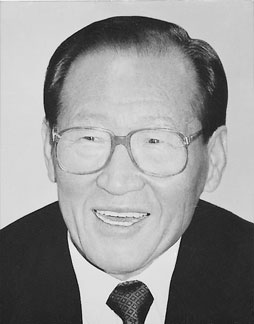 Chung Ju Young
Founder of Hyundai Group"Remembering Ho-Am"
It is a well-known fact that Ho-Am was an outstanding businessman. With his meticulous judgment and keen insight, he built the Samsung conglomerate and laid the foundation for it to expand beyond Korea’s borders onto the global stage.
Ho-Am understood well that business is fundamentally all about people. His passion for talent has cultivated a distinct corporate culture within Korea’s business world.
In the business world, success is not determined by how much capital you have. Regardless of what anyone says, business is a human endeavor, and its success or failure depends on the relentless efforts of the business leader and all those around him. Therefore, these efforts by all individuals, including the entrepreneur, must be properly recognized.
Ho-Am deeply understood well that business is fundamentally all about people. His business philosophy can be summed up in the phrase ‘People First.’ His enthusiasm for talent development was so profound that the term ‘Samsung Academy’ became widely used, shaping a distinct corporation culture in Korea’s business landscape.
However, Ho-Am’s passion was not limited to nurturing talent alone. He was very self-disciplined, and his immaculate attire was symbolic of his strict self-rigor. Moreover, his commitment to excellence in every facet of business is something that should be revisited and advanced further in today’s era of relentless competition. Instead of recounting stories and history that everyone already knows about, I would like to talk about Ho-Am's unique attitude toward competition. A businessman must possess the temperament of a risk-taker who can invest in an uncertain future with unwavering confidence. Success is not guaranteed to anyone. Therefore, I believe that assessing one’s capabilities and giving one’s all to the task at hand is not just a business approach but a life philosophy.
This is especially true for business leaders, as many people’s livelihoods depend on them, and they must possess foresight into the future and confidence in the face of uncertainty more than anyone else.
It is often said that a person’s true character is revealed during a game of golf, and I was able to see Ho-Am's attitude towards competition through the matches we played together. Even in friendly matches, he deeply hated losing. If he happened to lose, he would shake off the previous defeat by winning the next match. When people with similar skill levels play sports together, it is only natural for them to trade wins and losses back and forth. Did Ho-Am experience strong emotions to his win and defeats? In my view, he did not. It wasn't a simple obsession about winning or losing itself, but rather an unwillingness to accept when his desired play did not materialize. Ho-Am would have reflected on his play after losing a golf match. He would have identified his mistakes, corrected them, and use this as a foundation for the next game. In business, when one inevitably arrives at the crossroads of success and failure, there are times when one must make a clear-cut decision and at other times, one must reflect on oneself and wait patiently for another chance to come. In either case, without confidence and self-discipline, one can only falter midway. I believe that Ho-Am's attitude toward victory and defeat has been instrumental in Samsung maintaining its solid position since the 1960s. When Samsung entered the semiconductor business, no one expected that it would achieve the level of success it enjoys today. However, I knew that behind the success was a rigorous process of self-reflection and addressing the weakness every step of the way. Possessing a fierce competitive spirit to succeed and reflecting on one's shortcomings to overcome them are the path to realizing success! And on the long and difficult road to Samsung’s success, Ho-Am was standing right at the center.
-
Jack Welch
Former Chairman and CEO of GE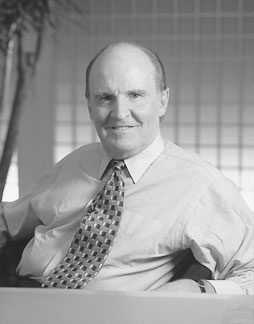 Jack Welch
Former Chairman and CEO of GE"A low-pitched voice with powerful ambition"
I met Ho-Am for the first time when he visited General Electric Company in the U.S. There was something very special about him as if he was shielded by an aurora. I had the impression that he was a very wonderful person. Americans generally tend to have loud voices, but even among them, Ho-Am spoke in a low voice, almost whispering, until the very end. So in order to hear him, we had to focus intently. Perhaps that is why I felt as if he were surrounded by an aurora. Just imagine us all leaning in to catch every word he spoke. At that moment, I felt as if I was being magically drawn in.
Ho-Am had tremendous ambition. I met him when he was already in his later years but even then, his energy and motivation surpassed that of someone much younger.
I had several occasions to meet Ho-Am in person concerning a joint-ventures between our companies, and during those times, I had a feeling that he and I shared a lot in common. I believe the four most essential qualities for a business leader are a sense of responsibility, people-centered management, the ability to place the right people in the right positions, and having a clear vision. Ho-Am was a business leader who possessed all these traits in equal measure. I especially agree with his principle of ‘People First.’ I was deeply moved when he once remarked that he pursued rationality in management not through working with robots, but through working with talented people. Even though Eastern and Western cultures differ, it is a common principle for both to seek talented people and consider them as family when managing a business.
When discussing Ho-Am's management style, his remarkable diligence and extraordinary interest in technology development cannot be overlooked. After seeing Ho-Am, I felt I could understand how the astonishing growth of the Korean economy, often referred to as a miracle, became possible. Moreover, Ho-Am had tremendous ambition. While it's easier to be entrepreneurial when someone is young, I met him when he was already in his later years. Even then, his energy and motivation surpassed that of someone much younger. Ho-Am aimed to make Samsung a global enterprise, and much of this stemmed from his belief in the technology of advanced nations.
About a month before he passed away, I met him in Seoul where we mainly discussed the future of our two companies and the potential for collaboration. But I noticed his voice was lower than usual. He didn’t look well either. I felt that his time was coming to an end, and he seemed to be aware of this. Nevertheless, he remained composed, giving his utmost to the work he had dedicated his life to until the very end. It was truly remarkable. I remember feeling a sense of solemn reverence, thinking that this was the disposition of a true master, achieved only by those who have given their all to their work. I also thought that if someone is a true business leader, they should stay at the forefront of management until the very end, giving their all until their last breath, just like Ho-Am.
-
Lee O-Young
Former Professor of Ewha Womans University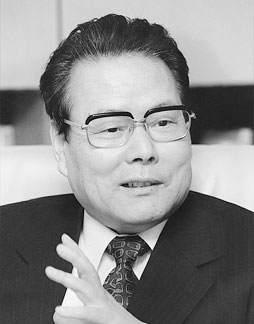 Lee O-Young
Former Professor of Ewha Womans University"A Golden Statue"
When I was an editorial writer at JoongAng Ilbo, I occasionally had the chance to meet Ho-Am, not in a formal setting, but at a Korean restaurant behind the Hankook Ilbo building that he visited regularly. One day after a meal, he invited me to ride in his car. It was pouring rain that day, so I could hardly decline.
It wasn’t merely about statues made out of copper and stone. He undertook a great endeavor to instill Korea’s intangible, enduring culture into the hearts of the entire nation.
As we drove past Sejong Street, Ho-Am gazed at the landscape outside and uttered “Oh my,” followed by a deep sigh. At the time, the military government had hastily installed makeshift plaster statues of the nation’s historical figures, but they were crumbling in the rain. Even to my eyes, it was a shameful scene. “That is the very image of our history and culture. While others erect statues that last for centuries, we create plaster figures that cannot even withstand a drizzle.” He spoke as if to himself, and I, listening beside him, boldly interjected: “Why not erect a magnificent statue instead? When visiting cities in Europe, what I envy most are their impressive statues.” My words carried a double meaning, as the words ‘statue’ (彫像) and ‘ancestor’ (祖上) are homophones in Korean. Ho-Am then looked at me with a serious expression and asked: “Please help me find a symbolic Korean cultural figure. The Japanese succeeded in modernization partly because they created statues of figures like Ninomiya Sontoku and made them role models for the nation. Not kings, politicians, or generals, but cultural figures who transcend our everyday lives.” Ho-Am’s words and proposals were deeply sincere. He stressed that the economy, politics and welfare of every family in a nation will only prosper on the basis of culture and morality, therefore, a model to be understood and respected by everyone is necessary.
Of course I agreed, but could not think of any cultural hero that matched Ho-Am’s vision. Eventually, I failed to keep my promise to him, and over time, the task was completely forgotten. But Ho-Am was different. Later, I saw him establish a cultural foundation and generously donate the wealth and cultural treasures he had gathered throughout his life to society. This made me realize that his sigh over the crumbling plaster statues in the rain was not a fleeting sentiment. Indeed, Ho-Am truly created monumental symbols of Korean culture that could withstand any storm. These were not merely sculptures of copper and stone, but rather, he undertook the enormous task of planting the enduring culture of Korea—that could last for thousands of years—into the hearts of the entire nation. He reclaimed national treasures that were looted by or illegally sold off to the Japanese and revived the nearly vanished Buddhist paintings, breathing new life into them on Korean soil as if creating a ‘Jurassic Park.’. While others collected antique paintings and calligraphy merely as investments or means to preserve wealth, Ho-Am devoted his fortune and time to preserve and cherish cultural artifacts purely for their beauty. . Everyone who has visited Hoam Museum of Art can feel this deeply. Had they been locked away in some individual’s closet, could we even have imagined the splendor of our culture? Ho-Am’s collections are like statues in a public square, visible to all, and admired not only by Koreans but by people around the world.
I have come to respect and love Koreans. He is not only a great entrepreneur, but a leading patron who loves and strives to protect Korean culture.
Ho-Am’s efforts were not limited to preserving cultural relics. Following Ho-Am's vision, his descendants established the 'Ho-Am Prize' to discover and honor cultural icons, like Ninomiya Sontoku, who embody both scholarship and diligence. Through this prize, leading scholars, both based in Korean and overseas, have been recognized and stand before us as living statues. I recall a discussion I had with the president of Pioneer Co. when I published my book Smaller Is Better: Japan's Mastery of the Miniature in Japan. Through his words I was able to once again confirm Ho-Am’s profound understanding and passion, as well as his unwavering commitment to cultural revival. The Pioneer president said to me as soon as we met, “I have heard much about you from Ho-Am.” He then added, “Through him, I have come to respect and love Koreans. Just a few days ago, I met Ho-Am in Seoul. He is not only a great entrepreneur, but a leading patron who loves and strives to protect Korean culture. When we meet, we don’t discuss business, but rather the deep, infinite beauty of Korea's culture.” Hearing this, I once again deeply engraved the image of Ho-Am in my heart, not only as a business leader, but as a man of culture. And then I saw before my eyes a vision of those shabby plaster statues crumbling in the rain on Sejong Street suddenly transformed one by one into magnificent golden statues. I silently said to myself, “Let us no longer shiver in the cold. We no longer need to endure the rain. As long as there are entrepreneurs like Ho-Am, Korean culture will never crumble like those plaster statues.”
-
Shin Yong-Ho
Founder of Kyobo Life Insurance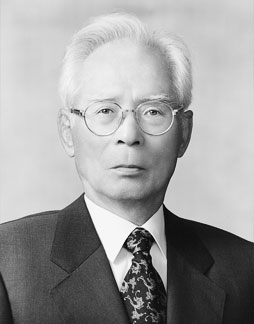 Shin Yong-Ho
Founder of Kyobo Life Insurance"The beautiful aura of Ho-Am formed by an exceptional sense of beauty"
Following decades of friendship, ever since my dear friend Ho-Am, who sometimes felt like a stranger and sometimes like myself, passed away first, I have a feeling of persistent loneliness. Where could one easily find another like him? Although it has been ten years since he passed away, my longing for him has not faded but has instead deepened over time.
Ho-Am’s style likely stemmed from his exceptional aesthetic sensibility, which recognized the extraordinary in the ordinary.
Ho-Am was a man of refined taste. You can understand every facet of his lifelong business pursuits was extraordinary, but the subtle fragrance he exuded as a human being was something that charmed every one of us. It was no secret that Ho-Am was quite the connoisseur of style. From the clothes he wore to accessories like fountain pens and belts, he insisted on only the very best. But his notion of the best was entirely different from the price tags or luxury brands that people often obsess over today. Before and after Ho-Am achieved financial success, Ho-Am had his suits tailored exclusively at a small, unassuming tailor shop in Tokyo called Baromon. Though the suits were inexpensive, the tailor was a diligent Chinese immigrant whose skills were anything but ordinary. Ho-Am was just as impressed by the tailor's way of life as he was by his craftsmanship. Ho-Am's sense of style likely stemmed from his exceptional aesthetic sensibility, which recognized the extraordinary in the ordinary. With such discernment, how could he not be particular about ordinary things?
He was a truly cultured man, capable of being moved to tears by the melancholy melodies of a lonely life's journey, and he knew how to enjoy such refined pleasures with friends.
Ho-Am was a man with a remarkable aesthetic sensibility. Above all, he knew how to listen to the melodies of our traditional music and cherished them deeply. A few times each week he would immerse himself in Korean melodies with two or three close friends. He didn’t enjoy drinking, so these modest gatherings were solely for listening to music. If one of his friends got bored with the music and interfered, he would calmly stop him by saying, “Oh, just listen to the sound for a moment.” He especially enjoyed certain passages in the ‘gayageum’ instrument accompaniment to the pansori ‘Heungboga.’ He would close his eyes and lose himself in the sound, then suddenly slap his knee when a beautiful melody broke off, exclaiming, “Ah, how exquisite!” Even now, I can vividly recall how he would remain captivated by that single passage, long after the sound had faded, immersed in his own private delight for quite a while. He was a true connoisseur and enthusiast of our culture, one who could be moved to tears by the sorrowful melodies of life's transience. He was one of those rare people who really loved and enjoyed the deep meaning of Korean traditional music. Although I also cherish our music, I doubt I could ever match Ho-Am’s discernment. During the era when Korean traditional music was neglected, it was Ho-Am who quietly supported many traditional musicians—those who were so captivated by our melodies that they willingly chose poverty—both materially and spiritually, encouraging them to never lose hope. There are few traditional musicians in Korea untouched by Ho-Am's influence and his support extended to every corner of the history of Korean traditional music. Though few may know it, perhaps Ho-Am’s impact on Korean traditional music rivals his achievements in the business world. No matter what anyone says, I firmly believe that it is precisely this refinement in daily life that made Ho-Am truly Ho-Am. For a leading industrialist to embrace the philosophy of ‘coming into this world with nothing and leaving with nothing,’ it requires a certain cultivation, much like pottery being fired for days in a kiln. His appreciation for life’s elegance undoubtedly contributed to this. Ho-Am’s essence stemmed from his exceptional taste and was more than enough to captivate the world, which allowed him to recognize the extraordinary qualities of others. Both Ho-Am and I believed that every person should possess their own preferences and tastes, and without them, one cannot reach true excellence. Ho-Am’s essence stemmed from his exceptional taste and was more than enough to captivate the world, which allowed him to recognize the extraordinary qualities of others. I believe this is why Samsung is filled with so many talented people. It brings me joy to still recall the power of his presence, and thus makes me miss my dear friend who left us too soon all the more.
- Home
- Ho-Am
- Philosophy and Belief
- Remembering Ho-Am
-


